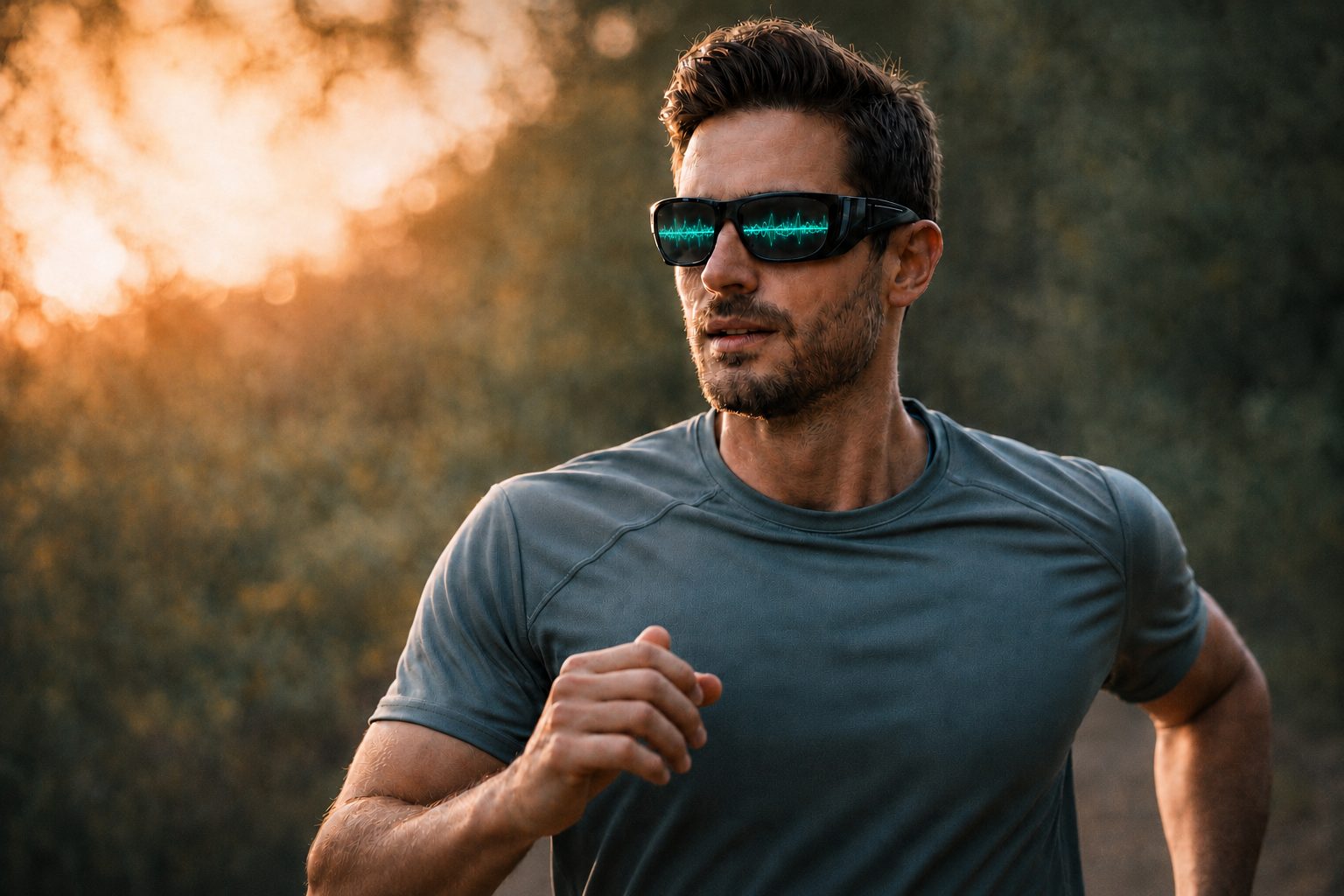
An ambient immune-monitoring system that shows a patient their treatment is doing something — without telling them whether it's working.
Context & constraints
This project wasn't inspired by a professor's assignment to create something, but rather by a problem I saw having a major impact — at least in the environment where I grew up. A relative of mine spent months trying to treat a rare illness with various specialists, yet nothing seemed to work. The frustration of not knowing what was happening, or whether a solution would come, was overwhelming. It wasn't just her; many people endure that same anguish during medical treatment. When the moment was right, the idea struck me: what if people could see what was happening inside their bodies? They would have more control than simply waiting blindly for something to work.
The brief itself was one line: make something in AR. First semester, MA Generative Design and AI. Three months, solo, no budget, no hardware.
The premise is speculative. Immunify assumes a population of implanted nanoscale sensors, placed during clinical onboarding, reporting raw chemistry from blood and tissue. Sensors at that precision don't exist yet; the principle does — glucose monitors have reported continuously from under the skin for twenty years. Immunify adds many sensors, many immune signals, each far fainter than glucose.
Strategy
The audience is not "chronic patients." It's a patient inside the treatment-evaluation window — the six months after starting or switching a therapy, when the central question of their life is whether this one works.
That narrowing makes Immunify time-bounded rather than an ambient wellness object, and it names the state I was designing for: not curiosity, anxiety.
So I rejected the score. The anxiety comes from the silence between appointments, and a number doesn't fill that silence — it replaces it with a judgement. A 12% shift reads as good or bad, and the patient has no basis to know which. Sound and colour let them see that something is moving, and which way. That is enough to stop waiting blind.
What the device won't do is pronounce at a single moment, when a bad week and a failing therapy look the same. Immune activity moves for reasons unrelated to the drug, and some biologics do nothing for twelve weeks and then work. Across the window a recovery shows, and the patient reaches that conclusion themselves.
The wave still has to be readable. At the visit where the sensors are placed, the doctor explains how it should behave for this drug and this patient — spoken, and on paper. A shape to expect, not a date: "settled by week eight" turns week nine into a verdict.
The doctor sees the same wave at each appointment, and nothing in between. The difference is knowledge, not access. And the numbers still exist, in the bloodwork, read by someone qualified to read them.
The form came before the data. A wave is defined by the same variables as a piece of music — rhythm, tune, amplitude. So instead of visualising numbers and then adding audio, I looked for the object where image and sound are the same thing.
If a patient can't understand every detail of their immunology, then a few crucial variables have to carry their state — and those variables drive the performance.
That produced the decision I'd defend hardest: one variable has to be identity — unique to the person, fixed for life, setting their base colour and timbre while state moves everything else. I specified that requirement. I don't know biology, so I used AI and expert checks to find which biological variable satisfies it. Nobody else's Immunify looks or sounds like theirs.
And AR rather than a phone: a phone makes monitoring an event. You decide to check, you brace, you interpret. That check-in is the anxiety loop.
Process
I brought versions to my professor, to my wife — a biologist — and to two medical friends. Most of them came back wrong.
The wave came from music before it came from medicine. The reference I kept returning to was the video for Arctic Monkeys' Do I Wanna Know, where a pulsing waveform behaves less like a graph and more like a character. A form that performs rather than reports.
The direction I spent longest on and killed was a realistic simulation of immune activity — anatomically faithful, cells and signalling rendered as they are. I abandoned it once it was clear the immune system is too complex to read at a glance even with a clinician explaining it. Abstraction wasn't a preference; it was the only way the data became perceivable.
A second direction died faster: an app pairing fictional narrative with scientific explanation. My professor's response was that a patient wanting medical literacy should buy a book, and that I was forcing my love of cinema into a product that didn't need it. He was right.
The first working version put waves around the entire field of view. It obstructed vision and would have been unwearable, so wave size and vertical position became user-controlled.
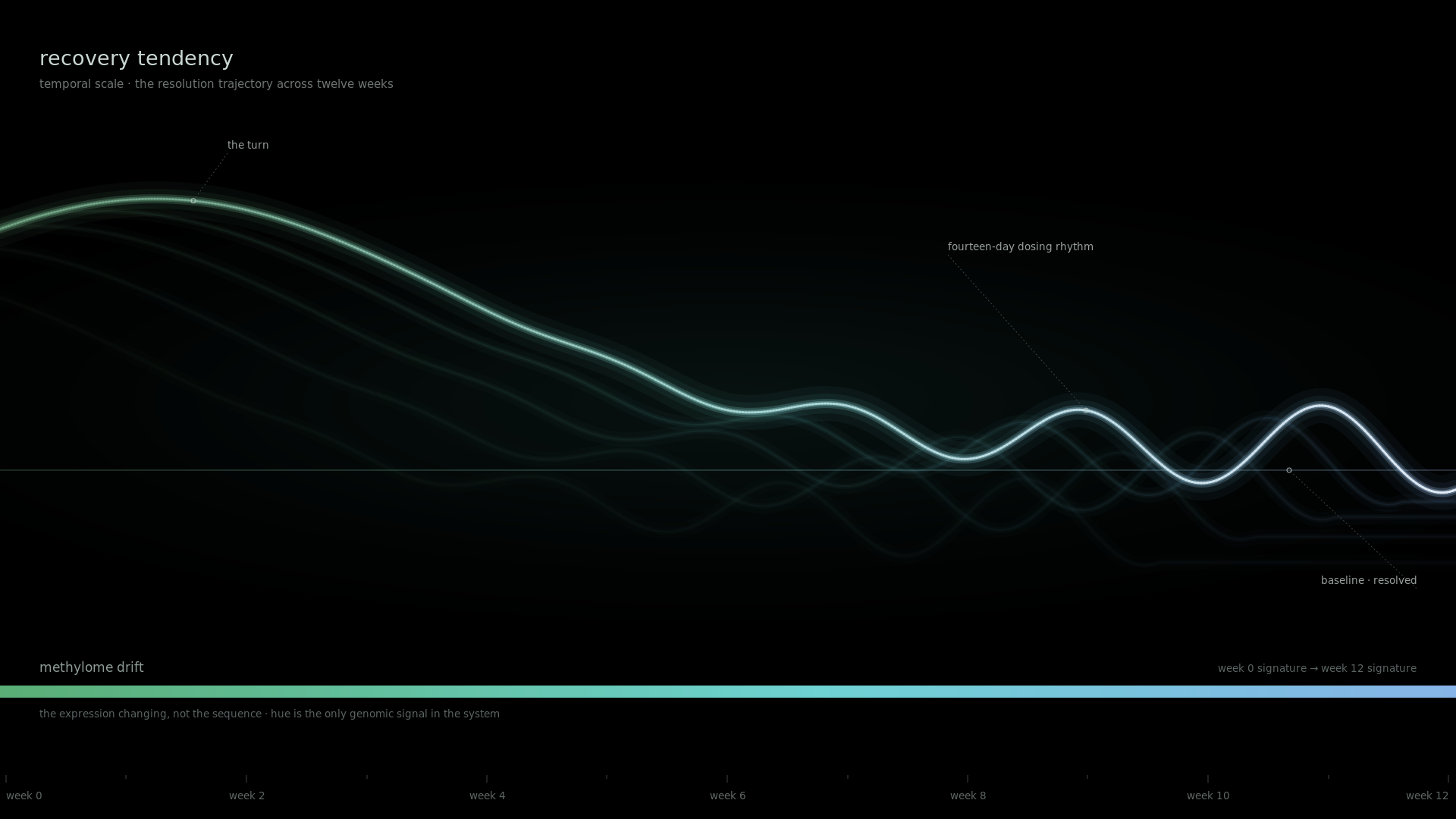
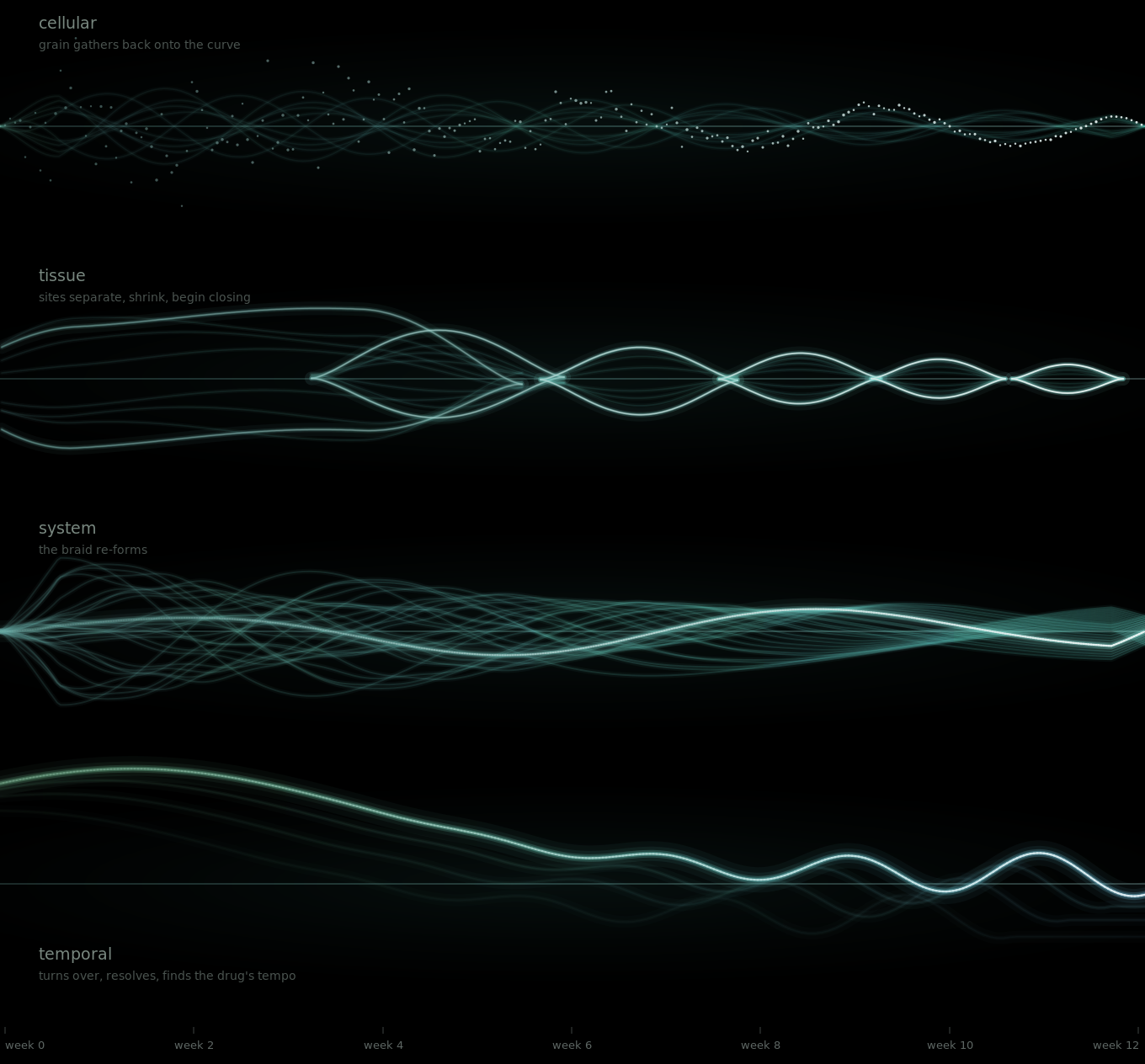
Then the mapping. Instability reads as noise, holes, desaturation; sonically as detuning, broken tempo, disrupted silence. Stability reads as saturation and harmony — the state is heard as settled or unsettled rather than measured. Four scales exist, three places in the body plus the accumulation across the window, and only one shows at a time.
My classmates wanted more — disease prediction, fainting alarms, cutting the doctor out of the loop. I refused all of it. A system built to reduce anxiety cannot also be an alarm system.
AI in the workflow
ChatGPT helped me consolidate the idea and find the biological framing to build the health state on. MidJourney, then Grok, generated the waveform aesthetics; Suno generated the sound pieces.
The more important decision is where I took AI out. The model agreed with everything I put to it — sycophancy, in a project where I was the non-expert and being wrong about immunology would have invalidated the concept. So I moved every feasibility question off the model and onto humans: my wife, a biologist, and two medical friends. AI stayed on generation and articulation. Judgement about what was true stayed with people who could say no.
That split is the method I'd bring to any project: I specify the requirement, AI reaches the domain I don't have, a human who can say "no" checks the answer. The design decisions were mine. The biology underneath them was sourced, then checked.
The method isn't complete: the current draft of the visual language goes into more biological detail than I've put back in front of an expert. I treat that detail as unverified.
Craft
The scales are not four ways of drawing the same reading. They are four different things to listen to: sensors at one site, sensors across one tissue, the whole population pooled, and the accumulation of all of it across the evaluation window.
You get one at a time. The sensors report from everywhere at once, but the wave is a single object and its rules compose one set of voices into one shape. Feed it two scales and the shape stops meaning anything.
The fourth behaves differently on purpose: it is the only scale that shows without closing, an accumulation you watch build across weeks with no endpoint that says you have arrived.
Outcome & learning
84/100 and a hostile review survived — the only external result it has. The premise held up against a biologist and two clinicians. The experience was never put in front of a patient.
What I'd validate first is the mapping: show someone an unstable and a stable state with no explanation and ask what they think is happening. If people can't read the difference, the concept fails. That test costs a room and six people.
Self-critique: I argued hardest for the half of the system I didn't build. Sound is what makes this ambient rather than something you consult, and it exists only as a specification. Every variable in the visual language has a stated auditory twin. None have been made.